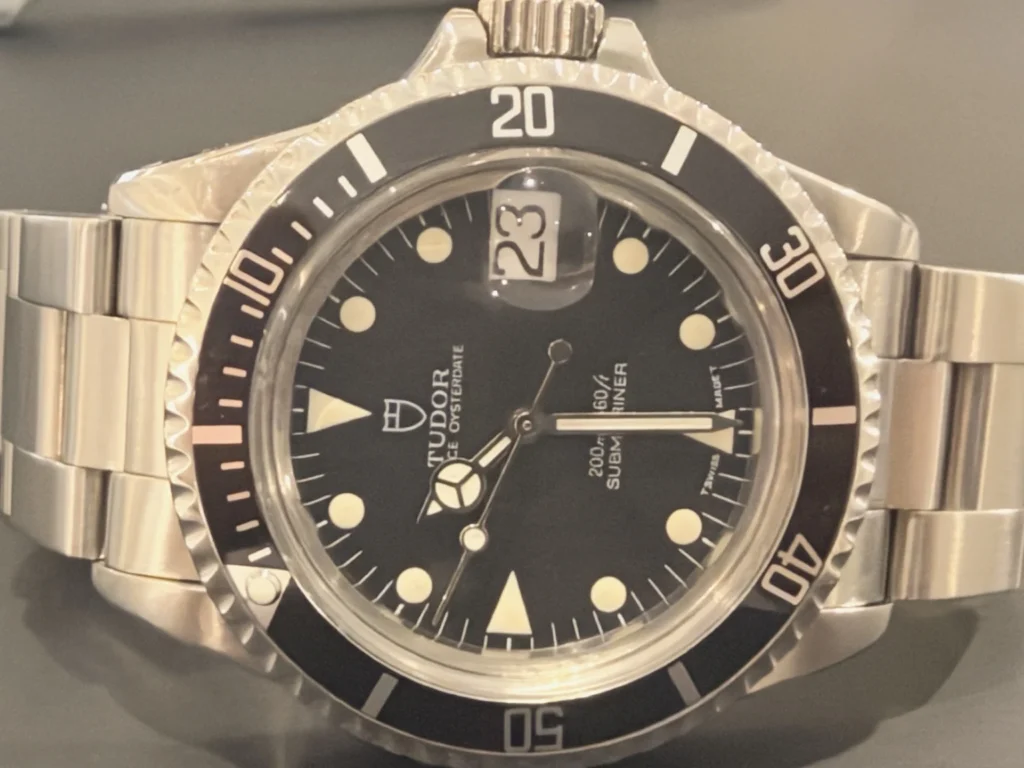
A customer brought a vintage Tudor Submariner 79090 to Ross Watch Repairs after noticing small particles or dust beneath the crystal and that the watch appeared to be losing time. Rather than requesting a complete movement overhaul, the customer booked it in for a dial clean and mechanical regulation.
We carefully inspected the watch, cleaned the dial, regulated the movement, resealed the case and carried out pressure testing. The timegrapher photographs document the timing checks, but the water-resistance tests produced mixed results: one stage passed and the other failed. We advised the customer not to swim with the watch or expose it to steam or excessive moisture.
Repair at a glance
Watch Vintage Tudor Submariner 79090
Problem Dust beneath the crystal and slow timekeeping
Work Dial clean, regulation, reseal and pressure test
Timing Regulated – a later timegrapher reading showed about +3 s/day
Water test One stage passed, one failed – not suitable for swimming
01 · The problem
Why This Tudor Submariner 79090 Came In for Repair
The customer could see what appeared to be dust under the glass. On a vintage watch, these particles may be residue from ageing luminous material on the hands or dial, or other debris within the case. We cannot determine their precise source solely from the appearance of the particles, but deterioration of older lume is one possibility worth investigating.
The customer had also noticed the watch was running a little slow. Our agreed work therefore focused on two specific issues: cleaning the visible dial area and checking and adjusting the mechanical movement’s rate.
02 · The reference
The Tudor Submariner Reference 79090: A Vintage Diving Watch
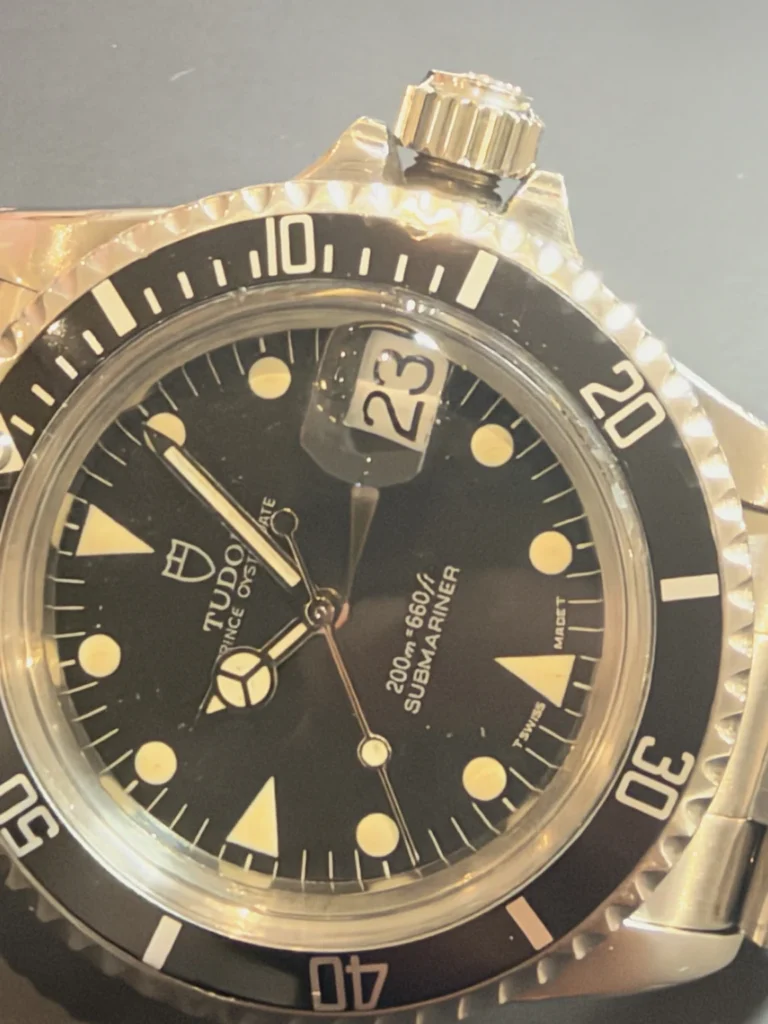
The Tudor Prince Oysterdate Submariner reference 79090 is part of the brand’s historic range of automatic dive watches. According to Tudor’s official Submariner history, the reference appeared in 1989, was offered with black or blue dials and used a self-winding ETA 2824-2 movement. The case was originally specified for 200 metres of water resistance.
Good to know Those original specifications are part of the model’s history, not evidence that a particular vintage example still meets them today. Decades of wear and ageing can affect crowns, gaskets, case surfaces and other sealing components. That is why we assess and test each watch individually rather than relying only on the marking on its dial.
03 · Inside the case
Inspecting the Automatic Movement and Opening the Case
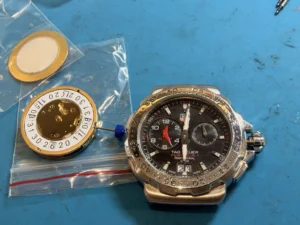
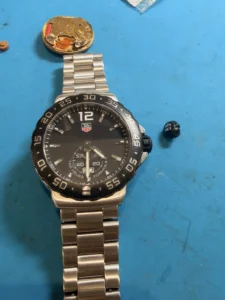
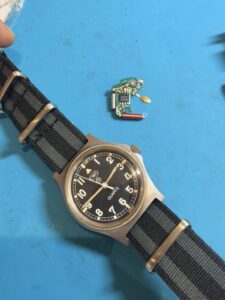
We opened the watch to inspect the movement and to carry out the agreed work. The workshop photographs show the automatic Tudor movement inside the stainless-steel case, with the caseback opened for access.
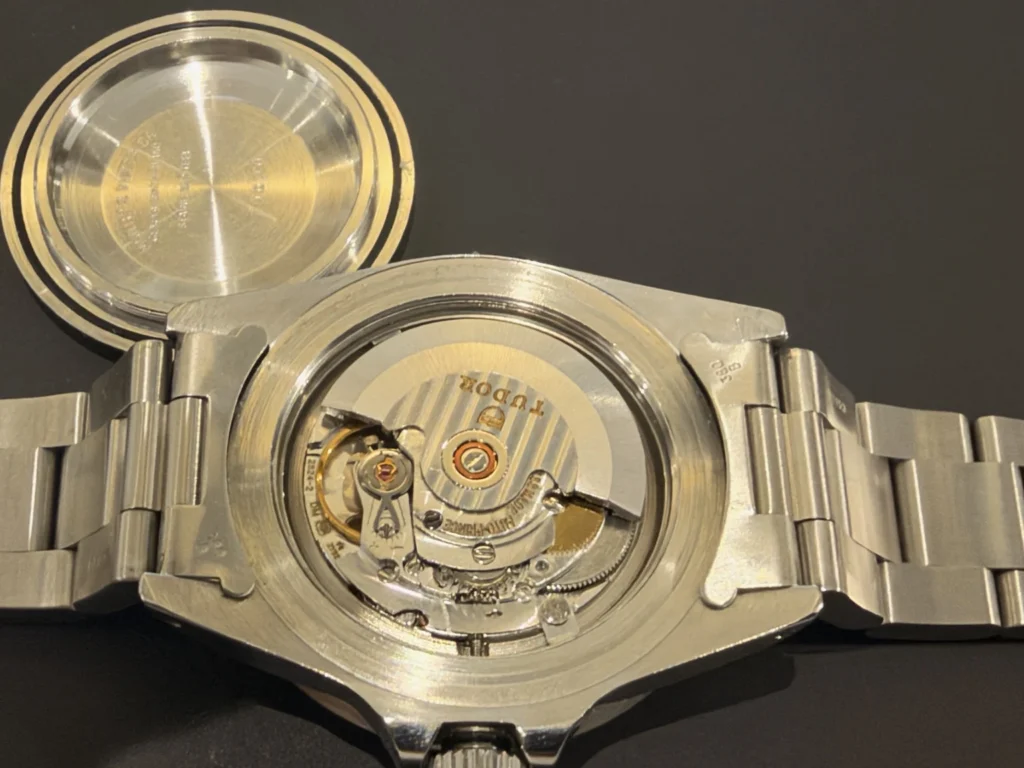
When working with vintage watches, maintaining the original character of the watch is often as important as restoring its performance. The aim here was to address the customer’s reported issues rather than carry out unrelated cosmetic changes.
04 · Dial cleaning
Cleaning Dust and Possible Luminous-Material Residue From the Dial
The dial and hands were accessed so we could clean the visible debris. A vintage Tudor dial deserves careful handling: the printed markings, luminous plots and hand lume may be delicate after many years, and unnecessary aggressive cleaning could alter the watch’s original appearance.
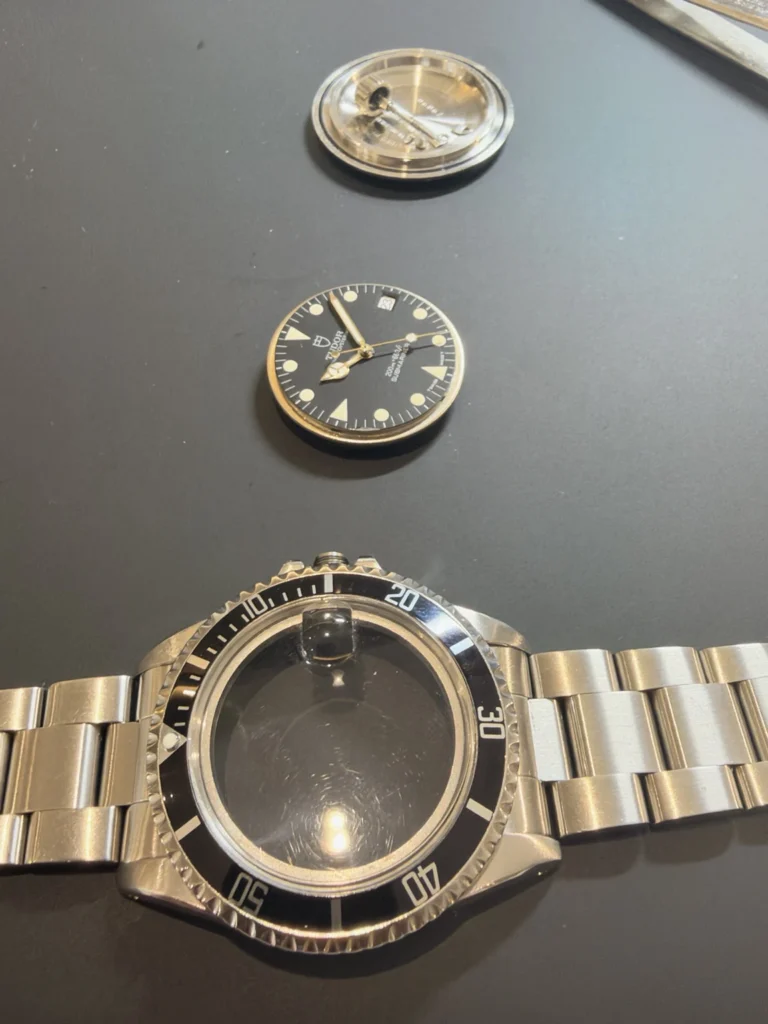
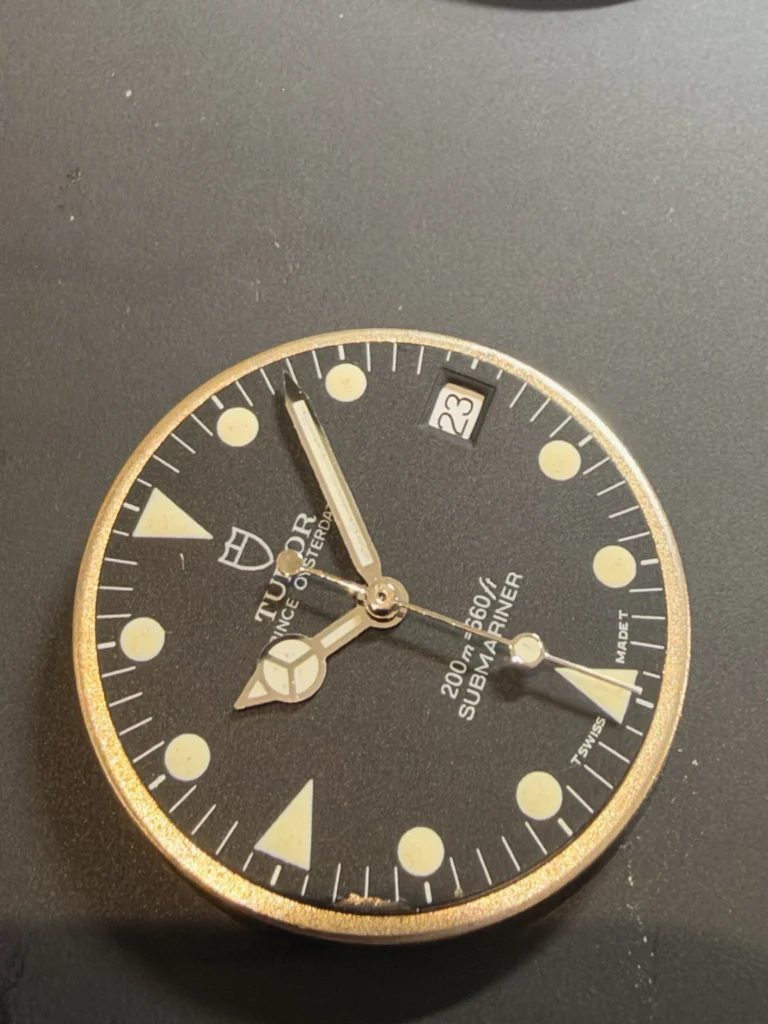
The work addressed the debris the customer had noticed under the crystal. A dial clean does not reverse ageing of luminous materials or guarantee that no further particles will appear in the future; the condition of the original hands and markers still matters.
05 · Regulation
Regulating the Tudor’s Mechanical Timekeeping
The customer also reported that the Submariner was losing time. We checked the movement on a timegrapher, which measures the rate, amplitude and beat error under particular testing conditions, and carried out regulation.
Two workshop photographs show readings of approximately –13 seconds per day and +3 seconds per day during the timing checks. The +3 s/day screen also shows an amplitude of approximately 285 degrees. These are snapshots taken under test conditions, not promises that the watch will keep exactly the same rate in every wearing position or over every day of use.
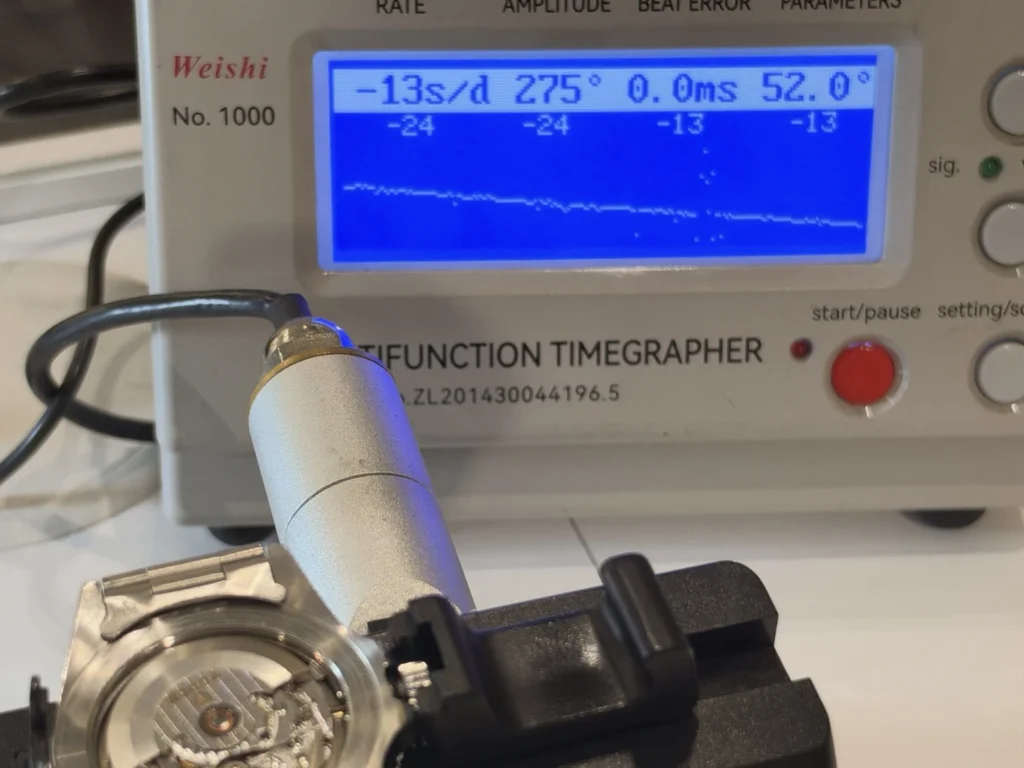
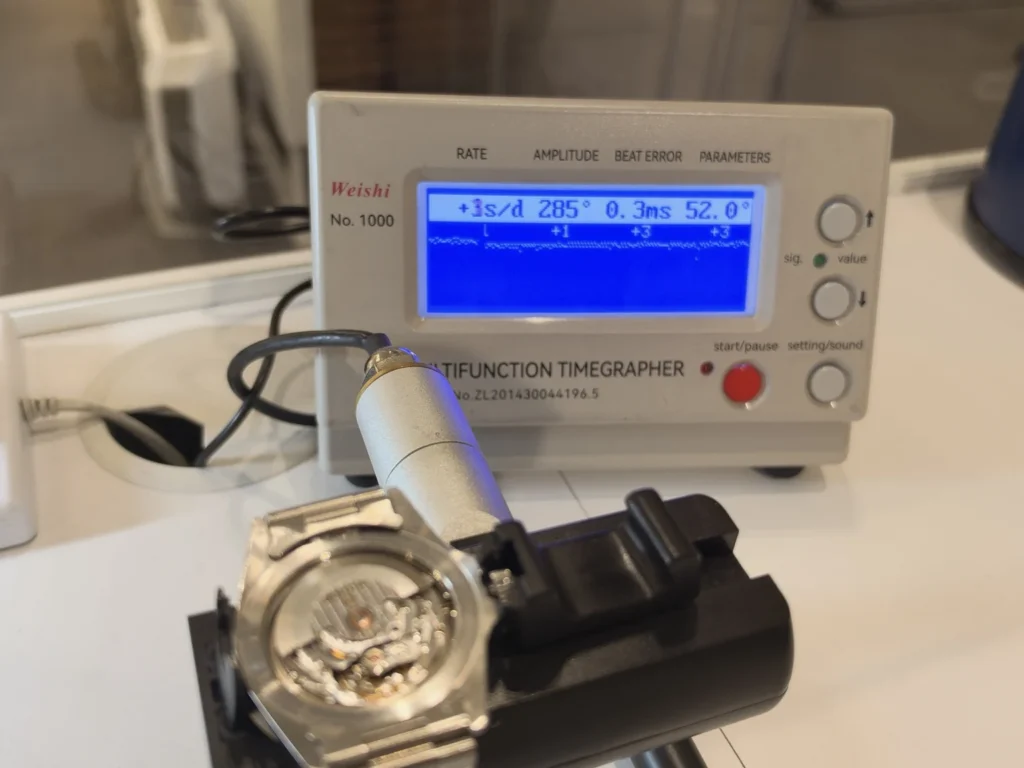
If a vintage mechanical watch continues to lose or gain substantial time despite regulation, a full service may be needed. In this case, the customer’s selected work was a dial clean and regulation, not a full movement overhaul.
06 · Pressure test
Resealing and Pressure Testing: One Stage Passed, One Failed
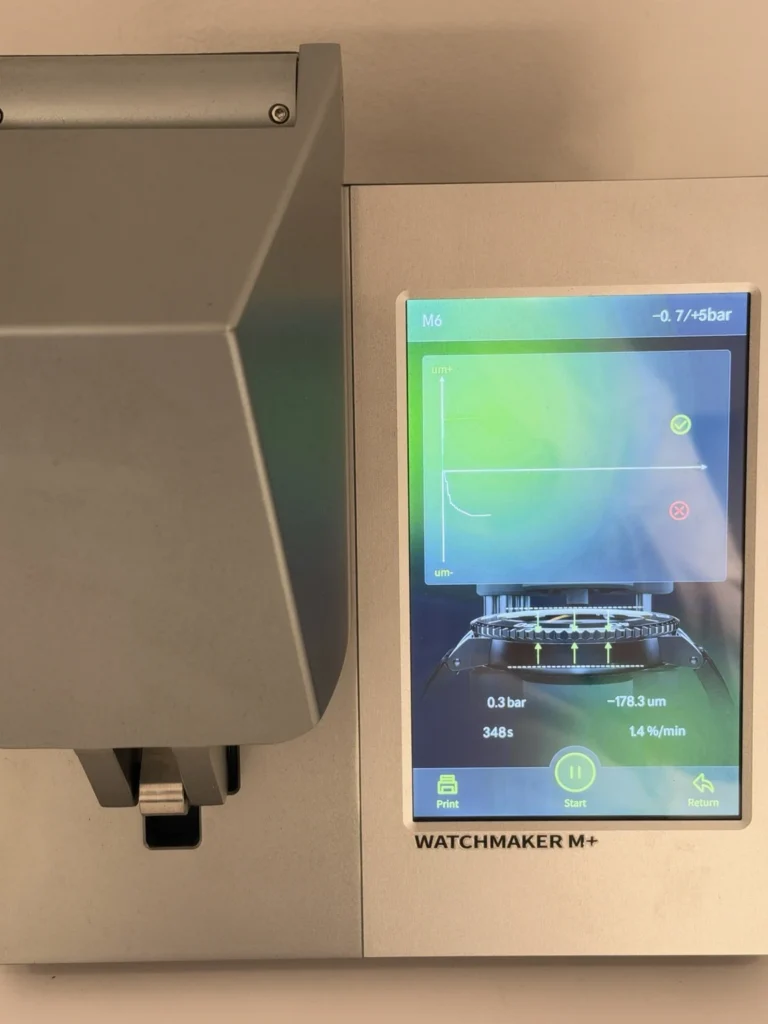
After the cleaning and regulation, we resealed the case and carried out water-resistance testing using our Watchmaker M+ equipment. The photographs record the watch under test and the results shown on the instrument.
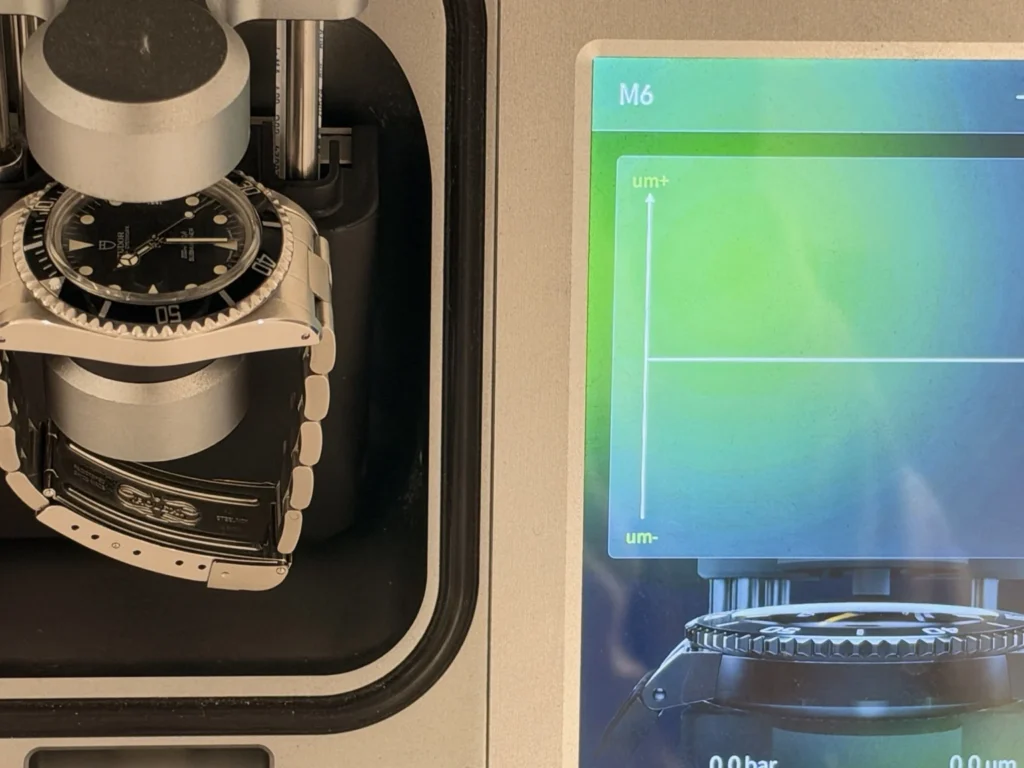
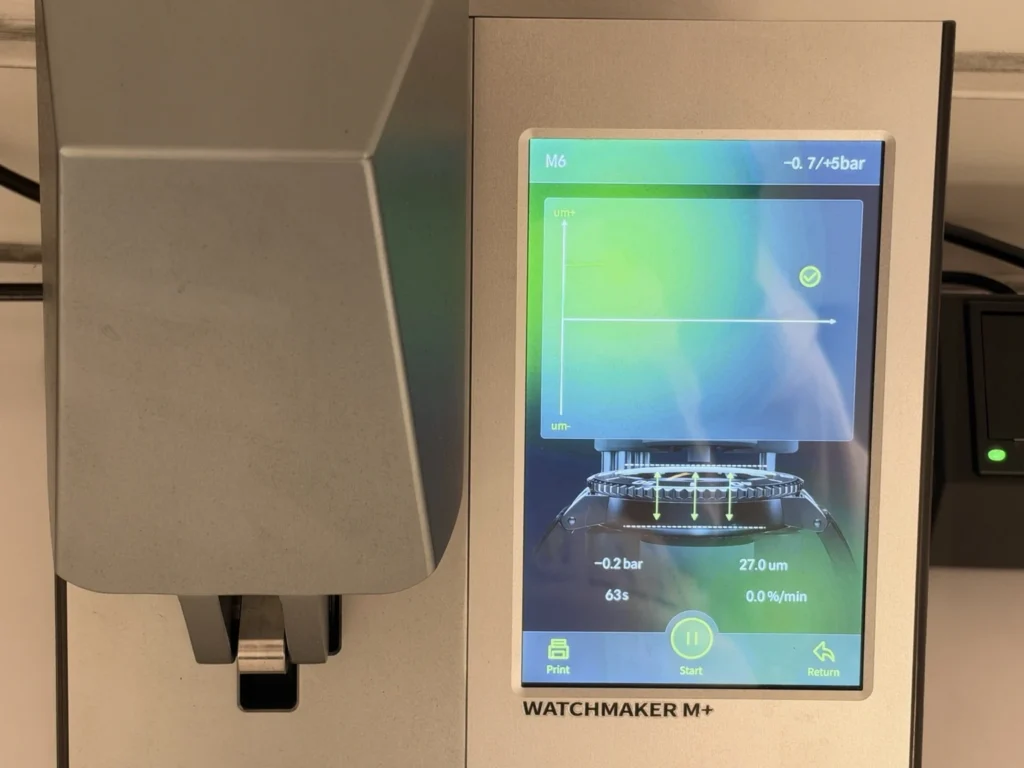
The important result is that the watch did not pass the complete pressure-test sequence. One test stage showed a pass, while another showed a fail. Passing only part of a water-resistance test does not establish that the watch is suitable for swimming or exposure to moisture.
The watch’s age may be a contributing factor, as older sealing components and case surfaces can deteriorate over time. However, a failed test alone does not prove which individual part of the case has lost its seal, and we should not claim a specific leak source without a separate diagnosis.
Advice
Can You Swim With a Vintage Tudor Submariner?
Although the Submariner 79090 was originally designed as a diving watch and marked 200m / 660ft, the original rating should not be assumed to remain valid indefinitely. Even a vintage watch that passes a particular test may still warrant conservative care depending on its age, condition and the scope of testing.
Important Our advice for this watch was clear: do not swim with it and keep it away from steam, showers, saunas and unnecessary moisture. Given that the full test sequence was not passed, we would not describe this individual watch as water resistant for swimming.
Tudor also describes waterproofness testing as part of its servicing procedures, demonstrating why proper testing matters rather than relying only on the original case rating.
07 · The result
The Finished Tudor Submariner 79090
The customer’s requested work was completed: the dial was cleaned, the mechanical movement was regulated, and the case was resealed and tested. We reported the mixed pressure-test outcome and gave the customer appropriate guidance for caring for a vintage watch.
The result illustrates an important part of independent watch repair: improving the watch’s condition and timekeeping while being transparent about what cannot be guaranteed, especially its water resistance.
Work carried out
- Watch inspected The case was opened to inspect the automatic movement.
- Dial cleaned Visible debris beneath the crystal was carefully cleaned from the original dial.
- Movement regulated The rate was checked on a timegrapher and regulated.
- Case resealed The case was resealed after the cleaning and regulation.
- Pressure tested One stage passed and one failed, so we advised keeping the watch away from water.
Free assessment
Dust under the glass, or a vintage watch losing time?
Bring your watch to The Shard or Canary Wharf, or send it to us by post. We assess watches free of charge and confirm the cost before any work begins.
Visit or post
Vintage Tudor Watch Repairs in London and by Post
Ross Watch Repairs provides free assessments for vintage and modern Tudor watches. We can inspect dust beneath the glass, assess timekeeping issues, investigate moisture ingress and discuss service or part-repair options based on the watch’s condition.
You can read more about our watch servicing and overhaul, watch part repairs and postal watch repairs.
The Shard / London Bridge
Ross Watch Repairs, 306 The Shard Retail Arcade, London Bridge St, London SE1 9BZ.
Canary Wharf
Ross Watch Repairs, Unit 4B, Cabot Place Shopping Centre, Canary Wharf, London E14 4QT.
Postal repairs Postal customers should send watches to the Canary Wharf branch by Royal Mail Special Delivery, including their name, telephone number, email address, return address and a note describing the fault or work requested. Assessment is free and payment is due on completion. A £15 postage and packaging charge applies to postal repairs under £50, assessment returns and warranty returns.
FAQs
Frequently Asked Questions
What causes dust beneath the glass of a vintage Tudor Submariner?
Loose material may come from ageing luminous paint on the hands or hour markers, or from other debris inside the case. A watchmaker needs to examine the actual watch to identify the cause.
Can a Tudor Submariner that is losing time be regulated?
Sometimes. Regulation can adjust the daily rate of a mechanically healthy watch, but it does not replace worn parts or substitute for a full service when the movement requires one.
Does passing one pressure test mean a watch is waterproof?
No. This Tudor passed one stage but failed another, so we advised the owner to avoid swimming, steam and moisture exposure.
Is a vintage Tudor Submariner still waterproof to 200 metres?
Not necessarily. The marking reflects the model’s original specification, not a permanent guarantee. Water resistance depends on the current condition of the seals, crown, case and other components and must be verified by appropriate testing.
Can I send a vintage Tudor for repair by post?
Yes. Ross Watch Repairs accepts postal repair enquiries across the UK at its Canary Wharf branch, with free assessments and Royal Mail Special Delivery recommended for sending watches.